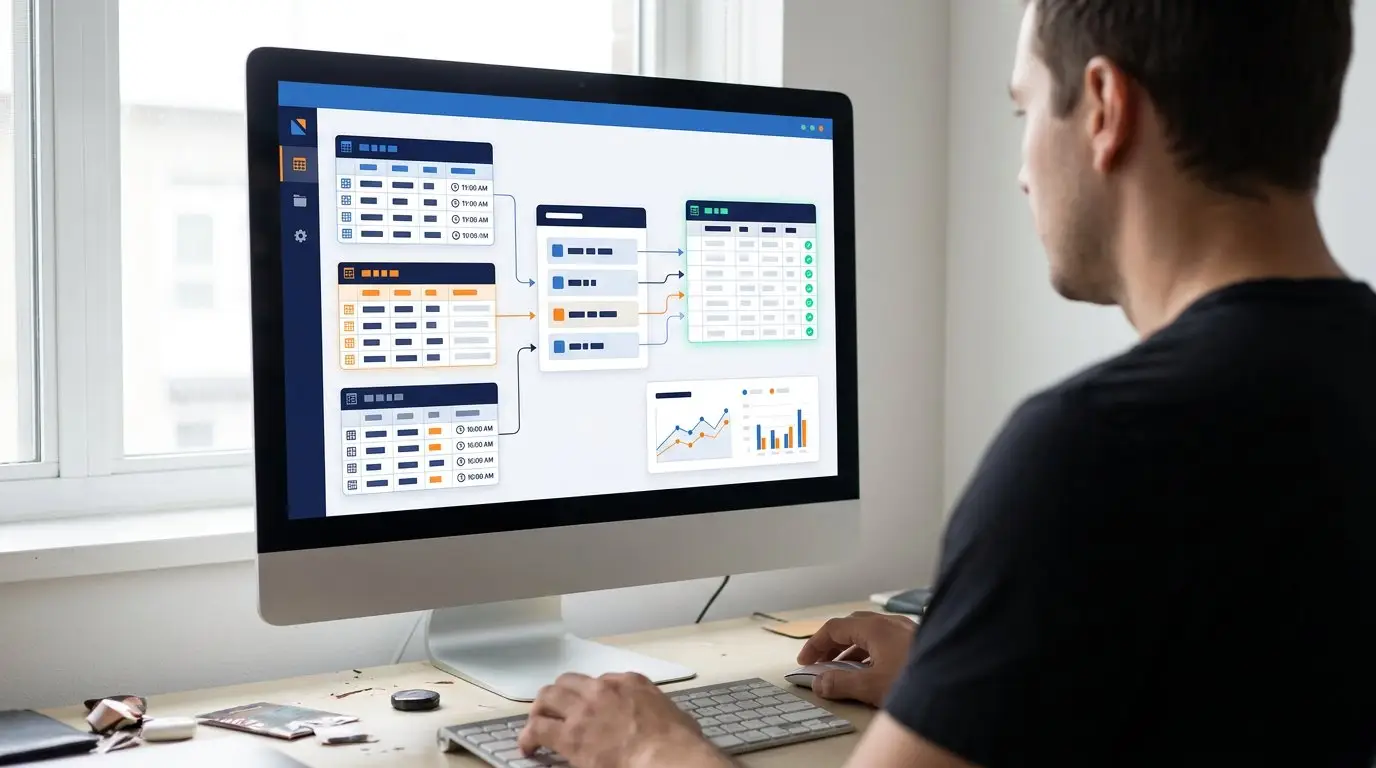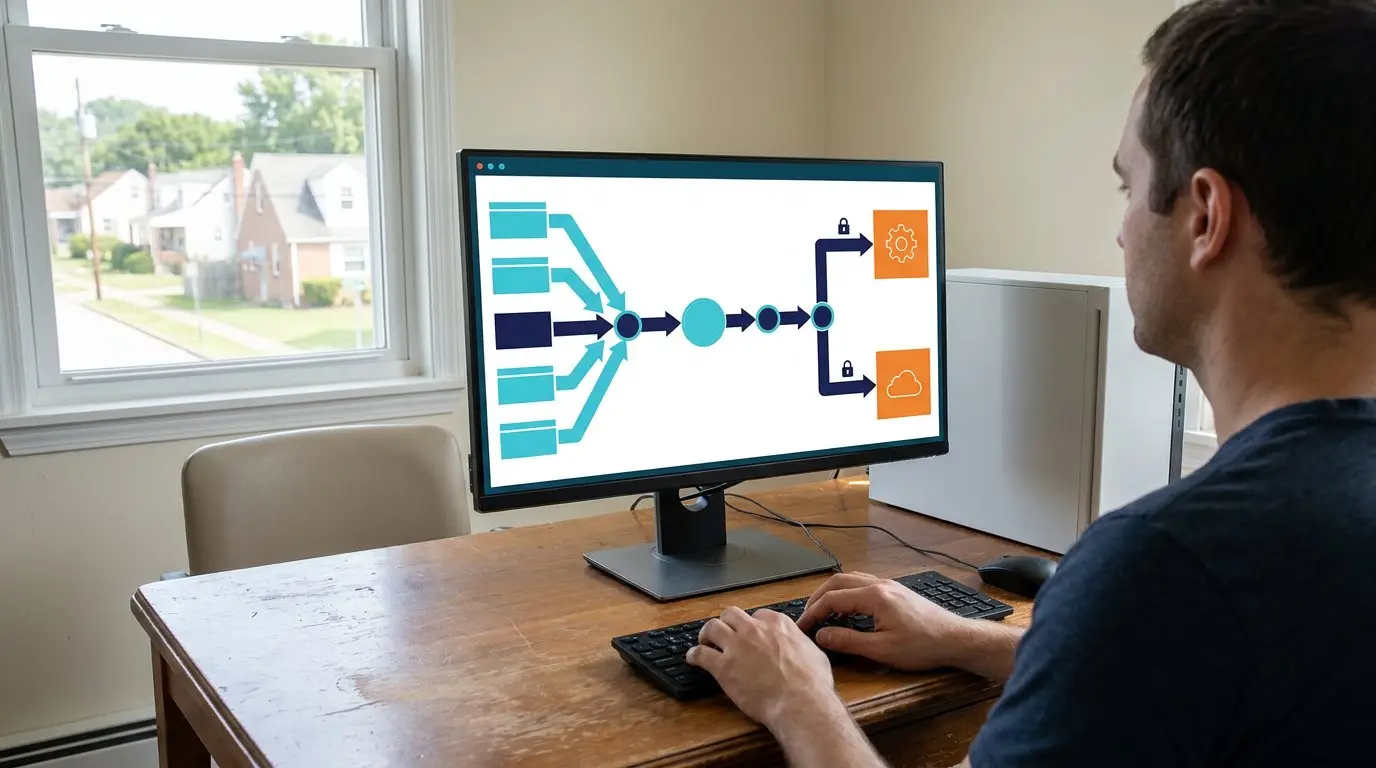
For organizations in West View, Pennsylvania, a data platform for AI workloads is an integrated architecture that ingests, standardizes, stores, governs, and delivers data to models and connected systems across the data lifecycle. It brings data formats and processing environments together so teams can develop, deploy, and operate AI using consistent access to trusted information.
That foundation matters because AI depends on more than model selection. Data quality, versioning, lineage, access controls, and the movement of information between training and production all influence whether workloads remain reliable as requirements evolve. Managing datasets as versioned assets also supports reproducibility as models and business needs change.
This article explains what a data platform includes and how to plan deployment around workloads, the data lifecycle, governance, security, and MLOps. It covers how cloud, on-premise, and hybrid approaches shape architecture, and how to align data formats, platform capabilities, and operating processes with current needs and future AI use cases.
Key Takeaways
- Plan platform capacity around current workloads and realistic growth to support reliable scaling and model operations.
- Align deployment choices with your data needs, operational constraints, and governance requirements.
- Manage formats, versions, and data movement across the lifecycle to improve consistency between development and production.
- See how the Lumascale Data Platform, Managed Services, and Professional Services can support AI data workflows.
Scalability, MLOps, security, governance, and compliance
Data platforms vary in architecture, built-in AI and machine learning capabilities, storage, pipelines, governance, and ecosystem fit. Compare how each handles your data sources, model workflows, access controls, and operating processes. For an organization in West View, Pennsylvania, include the needs of local teams and operations in your assessment. Assessing representative workloads can show which platform fits your technical requirements and existing environment.
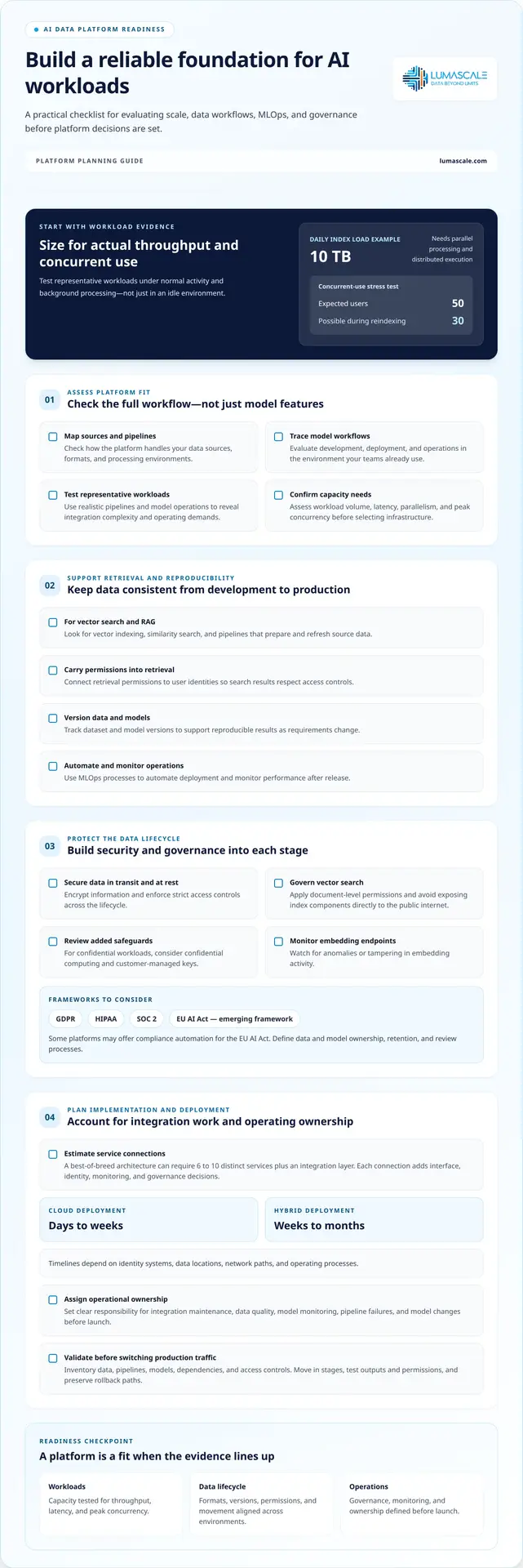
For vector search and retrieval-augmented generation (RAG), look for vector indexing and similarity search alongside pipelines that prepare and refresh source data. Connect retrieval permissions to user identities so search results respect access controls. This approach links relevant information to model responses while keeping retrieval within governed data workflows.
Scale for actual throughput and concurrent use. An AI platform expected to load 10 terabytes into an index daily needs parallel processing and distributed execution. Also test resource contention: a system supporting 50 concurrent users might handle only 30 during background reindexing. MLOps processes should track dataset and model versions, automate deployment, and monitor performance after release. These controls help teams reproduce results and identify production changes.
Security and governance must span the data lifecycle. Encrypt information at rest and in transit, enforce strict access controls, and avoid exposing index components directly to the public internet. For confidential workloads, consider confidential computing and customer-managed keys. Monitor embedding endpoints for anomalies or tampering, and apply document-level permissions to vector search. GDPR, HIPAA, and SOC 2 are frameworks to consider when evaluating platform controls. The EU AI Act is an emerging framework for which platforms may offer compliance automation. Governance should assign ownership, retention, and review processes to data and models.
Infrastructure and GPU requirements depend on whether workloads train models, run inference, or prepare data. Training often needs GPU compute, while ingestion, storage, and vector retrieval have different resource profiles. Assess workload volume, latency, parallelism, and peak concurrency before selecting infrastructure. A data platform coordinates these components but does not replace the compute capacity a workload needs.
Choose a platform by testing representative pipelines, access rules, and model operations against your requirements. This reveals integration complexity and operating demands before they influence long-term platform decisions.
AI platform implementation challenges
Implementation often stalls when teams connect tools before defining how data and models must move. A best-of-breed architecture can require 6 to 10 distinct services plus an integration layer. Each connection adds decisions about interfaces, identity, monitoring, and governance. For organizations in West View, Pennsylvania, a feature pipeline and inference service must use compatible data definitions to support reliable local operations. Without that alignment, teams spend time reconciling outputs instead of improving business processes.
To plan a migration, inventory source data, pipelines, models, dependencies, and access controls, then map each workload to its target environment. Move data and services in stages, validate outputs and permissions, and switch production traffic only after representative inference tests pass. Preserve rollback paths so teams can restore the previous workflow if validation reveals a defect.
Deployment timelines depend on these interconnected requirements. Cloud-based AI platforms can take days to weeks to deploy, while hybrid AI platforms can take weeks to months. Existing identity systems, data locations, network paths, and operating processes all shape the work. For example, a West View business with a workflow spanning an on-premises database and a cloud model service needs controlled data movement and consistent governance across both environments.
Compute planning presents another challenge. Training, batch processing, and real-time inference place different demands on processors, memory, storage, and network capacity. Identify these workload profiles before configuring environments. Then test peak demand, failure recovery, and access patterns using representative datasets. A well-planned configuration can support required response times while matching resources to the workloads that need them.
Operational ownership also affects implementation complexity. Account for integration maintenance, data quality controls, model monitoring, staff expertise, and governance processes. Assign clear ownership for pipeline failures and model changes before launch. A practical evaluation can compare workload performance, integration effort, and ongoing operational responsibilities using the same test cases. For guidance on platform capabilities, review AI data platform capabilities as you shape your implementation plan for West View operations.
Cloud-based, on-premises, and hybrid deployment models
Cloud-based AI platforms can take days to weeks to deploy, while hybrid AI platforms can take weeks to months. These timelines reflect differences in infrastructure, connectivity, and integration work. Cloud deployment lets teams provision platform capabilities without first building an on-premises foundation. For a West View business, a team can run data preparation and model inference in the cloud, then adjust capacity as workload patterns change.
On-premise deployment keeps platform infrastructure within an organization’s own environment. This can suit workloads tied to internal systems, established operations, or data that needs to remain close to its source. Consider a manufacturer serving West View and processing production records beside a factory system. Keeping ingestion and inference near that system can reduce network dependencies. The trade-off is that the organization must plan and operate the required compute, storage, network, and maintenance processes.
A hybrid architecture places selected workloads across on-premise and cloud environments. For example, a healthcare organization in the West View area might retain a source system locally while using cloud capabilities for model development. This can support distinct workload needs, but data movement, identity, monitoring, and governance must work across both environments. Before deployment, map each pipeline’s source, processing location, and destination. This makes dependencies visible and helps teams identify latency or access-control gaps.
Choose a deployment model by matching workload characteristics to operational constraints. First, identify where data originates and which systems need model outputs. Next, assess latency needs, data movement, security controls, and available infrastructure. Finally, test the proposed design with representative workloads before expanding it. A batch forecasting model may tolerate scheduled transfers, while a near-real-time decision workflow may depend on close connections between data and inference. These differences shape where each component should run.
For a data platform for AI workloads, deployment is an architectural decision, not simply a hosting choice. Cloud, on-premise, and hybrid models have different capabilities and operating demands. Align the model with the data lifecycle, integration needs, and your team’s ability to manage each environment.
Data formats, versioning, and lifecycle management
Data formats shape how an enterprise architecture stores, transforms, and serves information. A West View, Pennsylvania, business might ingest JSON events from a sales pipeline, standardize records, then publish analytical tables. Each transformation should preserve schema meaning and lineage so downstream teams can trace model inputs to their sources. This foundation supports generation, evaluation, and production use.
Version datasets alongside code, configurations, and model artifacts. For example, tie a training run to a defined snapshot of customer records and a specific feature pipeline. When results change, teams can trace whether the cause was new data, revised transformations, or a model update. Keep validation rules with each dataset version; otherwise, a changed field definition could alter inference inputs without an obvious error.
Lifecycle controls define how data moves from ingestion through transformation, training, serving, archival, and deletion. Set ownership and retention processes for each stage, then record access and lineage. For instance, a West View organization’s Microsoft-based reporting workflow may consume standardized tables while an AI pipeline uses a curated subset. Shared definitions help prevent different processes from interpreting the same field in conflicting ways.
Open table formats can help a data warehouse extend toward lakehouse capabilities without requiring an immediate commitment to the full complexity of a lakehouse. This allows teams to evolve existing architecture as use cases grow. Start with formats and metadata that support reliable reads, schema evolution, and reproducible training, then connect those assets to serving pipelines. To support faster iteration, test changes against a fixed dataset snapshot before promoting them to production.
For a data platform for AI workloads, lifecycle design is as critical as the initial storage choice. Map each dataset to its format, owner, version, and next processing stage. This makes data movement auditable and helps keep training and production aligned. If ongoing operations need dedicated support, discuss data lifecycle management through Managed Services.
Lumascale: The Lumascale Data Platform
For organizations in West View, Pennsylvania, the Lumascale Data Platform brings together data ingestion, standardization, analytics, and security capabilities in an environment designed for AI-driven workloads. It helps you connect data sources, prepare information for analysis, and make it available through capabilities such as APIs and visualization.
Turn to the platform when separate data processes make it difficult for your West View organization to manage information consistently across its lifecycle. Managed Services and Professional Services support platform operations and implementation, while Data Exchange supports data-sharing workflows. Together, these offerings can help you align data architecture with AI and analytics needs.
Contact Lumascale to discuss your data platform requirements.
Make your AI foundation ready for what comes next
Shape your data platform for AI workloads around the decisions your organization aims to improve. Treat architecture as an evolving business capability by aligning new data initiatives with clear ownership, practical operating processes, and measurable outcomes. This discipline helps the platform adapt as teams introduce applications and models.
The Lumascale Data Platform, Managed Services, and Professional Services support organizations as they develop and operate their data capabilities. Through Professional Services, Lumascale helps connect platform decisions with organizational needs and priorities.
Define the next capability your data environment must support, then identify the operational work required to deliver it. A focused discussion can help clarify how your platform direction aligns with that objective. If your organization is in West View, Pennsylvania, discuss your data platform with Lumascale and take the next step with confidence.
Frequently Asked Questions
What is a Data Platform?
A data platform is an integrated environment for collecting, organizing, processing, and delivering data to users and applications. For example, a West View retailer can bring sales records and inventory updates into shared workflows, then provide consistent information to analysts and operational teams. The platform connects data sources with storage, transformation, access, and analytics capabilities to support decisions across business functions.
What is a data platform for AI workloads?
A data platform for AI workloads connects governed data with the processes that prepare, serve, and evaluate it for machine learning. For example, a customer-support model at a West View business may retrieve approved knowledge articles while using separate training data. The platform coordinates these assets and their access, helping teams trace how data contributes to model behavior and update relevant inputs when source information changes.
What are the core components of an AI data platform?
Core components include data ingestion, storage, transformation pipelines, metadata and lineage, access controls, and interfaces for analytics or model services. A feature store or curated dataset can provide repeatable inputs, while orchestration coordinates scheduled jobs. Monitoring helps teams identify pipeline failures or unexpected data changes. The architecture depends on whether workloads focus on model training, real-time inference, analytics, or a combination.
How do AI data platforms handle structured, unstructured, and streaming data?
Platforms use ingestion and processing paths suited to each format. Structured records, such as transaction tables, can be validated against schemas; documents and images can be indexed or transformed into model-ready representations. Streaming events may be processed continuously or routed to storage for later analysis. Shared metadata, identifiers, and access policies help connect these distinct data types without treating them as interchangeable.
How do data platforms scale for AI training and inference workloads?
Platforms scale by matching compute and data movement to workload patterns. Training may process large datasets in parallel, while inference services need to handle incoming requests consistently. Teams can separate batch preparation from online serving, distribute processing, and monitor resource contention. For example, a West View retailer’s product-ranking model may train on historical activity while serving predictions against current catalog data.
What security, privacy, and compliance risks apply to AI data platforms in the United States?
Risks include unauthorized access to source data, sensitive information appearing in model outputs, and weak controls around embeddings or inference endpoints. Organizations handling health information should consider HIPAA, while SOC 2 may also be relevant when evaluating platform controls. Apply encryption, role-based access, document-level permissions, and endpoint monitoring. Map data flows and retention practices to the organization’s applicable obligations.