A data platform subscription gives your organization ongoing access to data capabilities under defined billing periods, terms, and access rights. The billing period sets the interval between bills, the billing start date marks when the first bill is due, and the subscription end date marks when the current term concludes.
A subscription covers more than recurring billing: its terms also shape when access begins, who or what can use the platform, and what happens when a plan changes or ends. Review these terms to understand the subscription period, billing dates, access rights, and how changes or the end of a term affect your subscription.
Key Takeaways
- Distinguish the subscription start date, first billing date, and end of the current term to understand when access and billing begin.
- Review renewal, upgrade, downgrade, and cancellation terms to see how a plan change can affect ongoing access.
- Identify who or what the subscription covers, then align that entitlement scope with your teams and workflows.
- Explore how the Lumascale Data Platform can connect data operations and analytics when your organization needs an integrated platform.
Billing period and start date
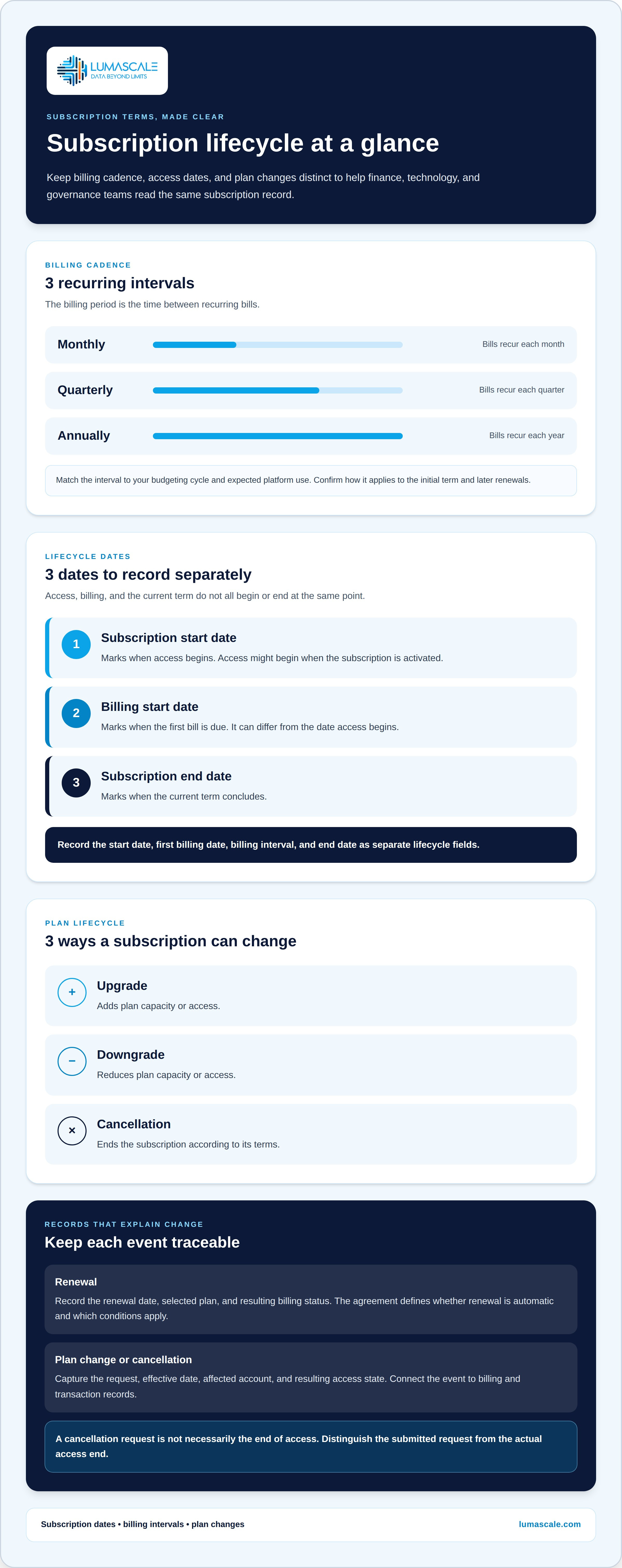
A subscription’s billing period defines the interval between recurring bills. The subscription start date marks when access begins; the billing start date marks when the first bill is due. These dates can differ, so clarify both before aligning a data platform subscription with your finance calendar. Access might begin when the subscription is activated, while the first bill follows a separate schedule. The end date marks when the current term concludes.
Billing may recur monthly, quarterly, or annually. Match the interval to your organization’s budgeting cycle and expected platform use. An annual interval may align with yearly planning, while a shorter one can suit changing requirements. Confirm how the billing period applies to the initial term and subsequent renewals. For accurate analysis, record the subscription start date, first billing date, interval, and end date as separate lifecycle fields.
Security, privacy, and compliance risks include excessive access to subscriber records, unclear data handling, and exposure of personal information. The European Union and California Legislature identify GDPR, CCPA, and platform-specific rules as relevant to businesses handling subscription customer data. Assess who can access records, how permissions are governed, and whether data practices align with applicable obligations.
Regulatory scrutiny also makes consent and data practices material to platform decisions. The European Commission fined Meta 200 million euros over its consent-or-pay system, which the EU declared violated the Digital Markets Act. This example concerns a specific system, but it underscores why buyers should examine consent flows alongside billing mechanics. Document how a subscription starts, what triggers its first bill, and when its current term ends. Clear records help finance, technology, and governance teams interpret the same subscription lifecycle consistently.
A subscription’s billing period field represents the time between billings. Keep it focused on the interval itself, rather than using it as a substitute for the subscription start date or first billing date.
Keeping these dates distinct gives reviewers a consistent way to interpret billing cadence alongside the subscription lifecycle. When comparing records or discussing a plan, describe the billing period as the span from one billing event to the next, and explain start and due dates separately. Consistent labels help finance, technology, and governance teams interpret the same information.
Renewals, upgrades, downgrades, and cancellations
Renewal and plan-change terms determine how software access continues, expands, contracts, or stops. Track each event in subscription records to connect service changes with revenue reporting.
Subscription Renewals
A renewal extends a subscription into a new term under the agreement’s conditions. Renewal timing affects continued access, revenue forecasts, and transaction tracking. For example, a team reviewing upcoming renewals can identify accounts that need a plan review before the next term begins. The agreement defines whether renewal is automatic and which conditions apply.
Record the renewal date, selected plan, and resulting billing status as separate lifecycle events. This creates a clear history for finance teams analyzing recurring revenue or investigating a change in access. If an account’s needs have shifted, assess whether the current plan still fits its users and workflows before renewal. Keep the renewal record connected to the account.
Plan Changes and Cancellations
An upgrade adds plan capacity or access, a downgrade reduces it, and cancellation ends the subscription according to its terms. These changes can affect entitlements, operational continuity, and revenue tracking. For example, a department adding analytics workflows may need expanded access, while a team consolidating software may reduce its plan scope.
For each change, capture the request, effective date, affected account, and resulting access state. Connect the event to billing and transaction records so reporting reflects what changed and when. Cancellation records should distinguish a submitted request from the actual end of access. This helps teams explain account status and reconcile revenue without treating every cancellation request as an immediate service end.
Email panels can track subscription-related communications, including subscriptions, trials, and cancellations. Keeping these messages available during renewal and plan-change reviews gives teams a communication trail for checking an account’s status. Distinguish correspondence about a trial from messages about a subscription or cancellation, and associate each with the relevant account record. Reviewers can then follow communications related to a lifecycle change alongside the subscription information.
Subscription platform definition and functions
A subscription platform manages recurring access to a product or service. It can collect account data, record subscriber activity, and connect transactions with engagement or retention analysis. For example, a software provider can use one platform to organize account status and subscription events. That shared record helps operations and finance interpret customer activity consistently.
The right option for a small business or enterprise fits its data sources, workflows, and governance needs. A small team may prioritize straightforward account tracking, while a large organization may need connected systems and analytics across departments. Compare capabilities with actual use cases, not feature volume alone.
For organizations in West View, Pennsylvania, requirements vary with data volume, source systems, integrations, and operating needs. Define the scope to identify an appropriate solution; a quote request can reflect those requirements rather than relying on a generic benchmark.
Choose a platform by mapping required sources, data transformations, access needs, and intended analysis. Define which systems connect, how records are standardized, and which teams use the outputs. During setup, establish data flows, validate sample records, and align reporting definitions. For example, a retailer can connect order and subscriber data to analyze engagement alongside recurring purchases.
Platforms can also provide lifecycle visibility by organizing events such as activations, plan changes, and cancellations. Teams can use that information in retention analysis to examine where subscribers disengage. Treat the platform as an operational data layer, not merely a billing interface: clear source connections and consistent definitions make downstream analysis more useful. Select capabilities for a specific workflow, then expand the architecture as requirements develop.
Entitlement scope
Entitlement scope defines who or what may use a platform and which capabilities that access covers. Align it with your teams as demand and growth change.
What a Subscription Includes
A subscription’s type field describes entitlement scope in terms of the number of people covered. This matters because individual and team access serve different operating models. For example, access assigned to one analyst does not automatically cover a whole department. Specify covered users, roles, and permitted workflows in the entitlement record, then align governance and onboarding with those boundaries. Revisit the scope when roles shift or departments combine.
Available Plans and Their Differences
Plans differ in entitlement scope and included functions. Since there is no universal plan menu, compare stated coverage with your users and workflows. Plans may distinguish individual from organizational access; the subscription type field describes how many people are covered. To choose a suitable plan, select the scope that supports current demand and can accommodate growth across teams such as data engineers and business analysts.
Trials and Free Tiers
Trials and free tiers depend on each subscription’s terms; they are not universal features. Treat each as a defined offer, not an assumed part of platform access. A trial may provide a time-limited evaluation, while a free tier may limit eligible users or functions. Check which users and capabilities are included before you begin, and assess whether the entitlement supports a realistic test rather than a narrow demonstration for streaming or another usage-intensive workflow.
Lumascale: The Lumascale Data Platform
The Lumascale Data Platform is a next step when your organization needs data capabilities aligned with its operating model. It supports data ingestion, standardization, analytics, visualization, and business intelligence for connected data workflows. Consider it when separate systems make it difficult to prepare information consistently or deliver useful analysis to decision-makers. Its capabilities connect data operations with practical business priorities.
For example, a team consolidating information from several applications may need a structured way to ingest and standardize those inputs before analysis. The platform also includes a data warehouse, API, automation, control panel, and security capabilities. Identify the workflow creating friction, then consider which capabilities directly support the outcome your team needs. This grounds platform selection in operational requirements rather than a broad feature checklist.
Managed Services or Professional Services can support platform operations or implementation. Data Exchange can serve workflows that involve exchanging information between systems. Lumascale’s team brings expertise in data platform architecture and implementation, helping organizations align platform capabilities with operating requirements. The right focus depends on your data environment, integration priorities, and intended business outcomes.
Use your current data workflows to frame the next discussion: identify disconnected sources, manual preparation, or reporting gaps, and describe the decisions those workflows should support. This gives the conversation a clear technical and business focus without assuming every organization needs the same approach. The Lumascale Data Platform is a relevant next step when your organization is ready to build connected data operations around its requirements.
Contact Lumascale to discuss your data platform requirements.
Frequently Asked Questions
What is a data platform subscription?
A data platform subscription is an agreement for ongoing access to a data platform. Treat it as both a technology decision and an operating commitment. For example, if your team plans to use data outputs in quarterly planning, define what successful access and useful information mean before selecting a subscription. This gives stakeholders a clear basis for assessing fit beyond the platform’s feature set.
What features are typically included in a data platform subscription?
Included features vary by platform and plan, so assess how well they support your data workflows. Consider whether teams can use consistent definitions and apply appropriate governance across their use cases. A retailer, for example, may need product records aligned before comparing performance across channels. Link each requested capability to a practical outcome, then distinguish essential requirements from features that do not support current priorities.
What contract terms, renewal rules, and cancellation policies apply to data platform subscriptions?
Terms vary by agreement, so review data portability and transition responsibilities alongside renewal and cancellation conditions. Determine how your organization can retrieve its information, which format it will receive, and how the agreement addresses data retained or deleted after access ends. Documenting an export requirement before a platform transition can help teams plan downstream system updates and maintain continuity for dependent business processes.