


A data warehouse is one part of a data architecture. An enterprise data platform coordinates how an organization ingests, integrates, standardizes, governs, stores, and serves data for operational and analytical workloads.
It brings batch and streaming inputs into a coordinated environment, connects source systems through APIs and connectors, and transforms data for use across applications, BI tools, and analytics teams. Catalogs, access controls, and query capabilities help teams work with governed data without treating every source as a separate pipeline.
Cloud platforms offer on-demand compute and storage, while traditional warehouses focus on storing and querying data prepared for analysis. Understanding the difference helps you assess how data moves from source to decision, where hybrid architectures fit, and which ingestion, integration, and management capabilities match your organization’s workloads.
Key Takeaways
- Trace how batch and streaming data moves through ingestion, transformation, storage, and integration to identify the capabilities your workflows require.
- Distinguish a platform that coordinates data assets across systems from a warehouse focused on analytical storage and querying.
- Assess cloud and hybrid architectures by how they support changing workloads, elastic scaling, and connections to existing systems.
- See how the Lumascale Data Platform, Managed Services, Professional Services, and Data Exchange can support coordinated data workflows.
Data ingestion, storage, transformation, and integration
An enterprise data platform coordinates how information moves from operational sources into storage and processing environments. It supports analytics, AI, and real-time processing by making incoming data accessible, structured, and ready for use.
Data Ingestion and Source Integration
Data ingestion and source integration bring information from applications, databases, and external systems into a shared architecture. Connectors and APIs can link an enterprise platform to many sources, helping teams combine structured data without building each connection from scratch. Integration matters because analytics depends on consistent access across systems. For example, retail teams can combine transaction and inventory records to examine stock movement alongside sales.
Batch and Streaming Ingestion
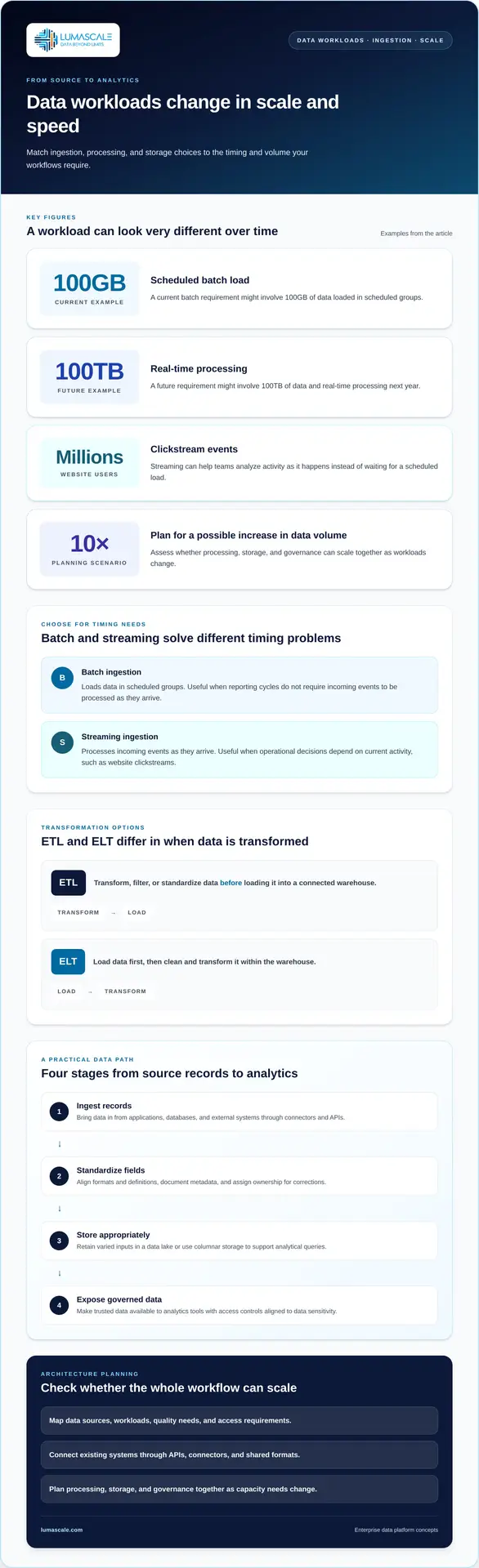
Batch ingestion loads data in scheduled groups, while streaming ingestion processes incoming events as they arrive. Both approaches matter because reporting cycles and operational decisions have different timing needs. A current batch requirement might involve 100GB of data; a future requirement might involve 100TB of data and real-time processing next year. Clickstream data from millions of website users illustrates why streaming can help teams analyze activity as it happens, rather than waiting for a scheduled load.
Storage and Processing for Analytics
Storage retains ingested data, while processing transforms it into usable inputs for analytics and AI. In an ETL pipeline, data is transformed, filtered, or standardized before being loaded into a connected warehouse. With ELT, data is loaded first, then cleaned and transformed within the warehouse. A data lake can retain diverse inputs, while columnar storage supports analytical queries. Parallel processing can run query operations across data to support timely analysis. These choices shape how teams address data quality, support learning workloads, and apply access controls for compliance. A practical sequence is to ingest records, standardize fields, store them appropriately, then expose governed data to analytics tools.
What is an Enterprise Data Platform?
An enterprise data platform is an architectural foundation for managing, governing, and using information across organizational systems. Implementation starts with mapping data sources, workloads, quality needs, and access requirements, then designing infrastructure around those priorities.
Enterprise Platform Architecture
A platform architecture combines storage, processing, catalogs, and access paths so teams can work with structured and unstructured data. A centralized design coordinates shared standards, while data mesh distributes ownership among domain teams and data fabric connects data across environments. Data lakes retain varied inputs; the architecture determines how teams discover and use them. The right model sets how responsibilities, infrastructure, and governance scale across departments.
Interoperability and Open Architecture
Interoperability lets systems exchange and query data through connectors, APIs, and shared formats. Open architecture supports integration with operational applications, BI tools, and external data sources rather than locking workflows into one storage location. For example, distributed queries and a data catalog can help analysts locate information across a warehouse and a separate data lake. This flexibility helps you preserve existing systems while adding new analytics capabilities.
Architecture and Quality Challenges
Architecture and data quality problems can arise when separate systems use inconsistent formats, definitions, or update schedules. A customer identifier that differs between a CRM and billing database can distort joined reports, even when ingestion works. Teams can address this by standardizing fields, documenting metadata, and assigning ownership for corrections. These controls make transformations more predictable and help prevent unreliable inputs from reaching dashboards or machine-learning workflows.
Governance, Security, and Compliance
Governance defines who can access data, how it is classified, and how its quality and use are managed. In the United States, organizations can use role-based access controls and map datasets to roles through frameworks such as Active Directory. HIPAA, PCI-DSS, and GDPR are relevant frameworks for organizations considering role-based or attribute-based controls. Align access policies with data sensitivity and organizational obligations, then apply them across storage and analytics environments. This makes compliance part of the architecture rather than a disconnected review.
Cloud data platforms
Cloud platforms provide on-demand compute and storage, allowing capacity to expand as workloads change. This gives an enterprise architecture a scalable foundation for applications, analytics, and data pipelines. Planning for a possible tenfold increase in data volume helps reveal whether processing, storage, and governance can scale together without requiring a redesign of every workflow.
Cloud-native platforms are designed around cloud infrastructure, while independent data platform vendors can offer capabilities that operate across environments. The distinction affects how you coordinate data across services, connect applications, and manage governance. Start by mapping workloads: a cloud-based analytics pipeline may need elastic processing, while a sensitive operational system may need to stay connected to on-premises infrastructure.
Cloud storage can hold data in formats that work across processing environments. Hadoop-compatible formats such as Parquet and ORC support connections between an enterprise platform and distributed data systems. These file formats are not the same as table formats, but they illustrate why compatibility matters. Teams can choose storage and processing capabilities around workload needs instead of treating each dataset as a proprietary island.
Hybrid architectures connect cloud-based and on-premises data warehouse instances. This approach can preserve existing systems while adding cloud capacity for variable workloads. For example, an organization might keep a core operational database on premises and direct a growing analytics pipeline to cloud compute. The architecture must account for data movement, access controls, and consistent governance across both locations.
Evaluate cloud capabilities against your operating requirements. First, map which applications produce or consume data. Next, identify where latency, security, and governance affect placement. Then test how pipelines move data across environments. A centralized cloud platform can support enterprise reporting, while data fabric principles can connect edge systems and legacy databases. Together, these approaches let you modernize incrementally and maintain visibility across distributed infrastructure.
Enterprise data platforms compared with traditional data warehouses
A traditional data warehouse stores and serves prepared data for analysis. An enterprise data platform coordinates access to business data assets across systems using metadata, rather than requiring all analytical data to reside in one place. It may also host warehouses. The distinction is architectural: a warehouse is a destination for analytical data; the platform connects destinations, sources, and workloads.
This difference affects how your organization handles growth and change. A warehouse-centered design can suit established reporting based on structured, prepared records. An enterprise data platform can support integration across warehouses, operational systems, and data lakes, including unstructured information. For example, an analyst might find customer data through a catalog while the underlying records remain in separate systems. Metadata helps show what exists and where it resides.
Processing needs also shape the comparison. A warehouse can focus on analytical queries, while an enterprise data platform coordinates access to multiple processing environments and applications. Some architectures use row-based tables for transactions and columnar storage for analytics. The useful question is not which label sounds more modern, but whether your current architecture supports required reporting, operational workflows, and future data sources without unnecessary duplication.
A provider helps you choose by assessing your data sources, workload patterns, integration requirements, and governance needs. The provider can then map those requirements to an architecture, including whether your existing warehouse remains central or becomes one component. For instance, a retailer with separate inventory, sales, and customer systems may need shared discovery and integration before replacing its reporting warehouse.
Use a practical decision sequence: identify the decisions your data must support, map the systems involved, then compare the required processing and access patterns. If the primary need is dependable analytical storage, a warehouse may be sufficient. If teams need governed access across distributed assets, a platform can supply the connecting architecture while retaining existing warehouses. To plan that architecture, discuss your data platform requirements.
Lumascale: The Lumascale Data Platform
The Lumascale Data Platform brings data ingestion, standardization, analytics, and business intelligence capabilities into a shared environment. It can support organizations connecting data workflows, preparing information for analysis, and developing AI-driven workloads.
Consider the platform when fragmented sources or inconsistent data limit reporting and operational insight. Lumascale Managed Services and Professional Services support platform operations and implementation, while Data Exchange supports data sharing. These offerings are a practical next step when your architecture calls for coordinated platform capabilities and expert delivery.
Contact Lumascale to discuss your data platform requirements.
Shape Your Next Data Architecture
Align data architecture with the decisions your organization needs to make. Define which workflows need shared data, which systems must stay connected, and how teams will govern access as the environment evolves. This turns an enterprise data platform from an infrastructure initiative into a foundation for more coordinated operations and analytics.
Lumascale supports data platform planning and delivery. The Lumascale Data Platform, Managed Services, and Professional Services can help organizations move from architectural priorities to integrated data workflows. The appropriate scope depends on your existing systems, data needs, and operating model.
Start a focused conversation about the architecture you need and the next practical step. Contact Lumascale to discuss your data platform. With a clear direction and experienced support, you can advance your data capabilities at a pace that fits your organization.
Frequently Asked Questions
What Can Agencies Do With EDP?
Washington State agencies can use the Enterprise Data Platform through self-service, hybrid, or full-support technical models. Participation is governed by applicable service agreements covering WaTech and agency responsibilities, security requirements, and service expectations. Category 4 approval applies per use case, and each agency needs design review and security approval before onboarding and data hosting. The chosen model defines how technical responsibilities are handled.
What are the core components of a data platform?
Core components include data connections, storage, processing, governance, and tools that make information usable. For example, a finance team may need scheduled transaction feeds, controlled analytical datasets, and query access for reporting. A catalog helps teams find relevant datasets, while role permissions govern access. Evaluating these capabilities together helps determine whether an enterprise data platform supports daily operations as well as analytical work.
Which vendors offer enterprise data platforms in 2026?
No single vendor leads for every organization in 2026; the right fit depends on workloads and existing infrastructure. Compare options by their ability to connect current systems, support hybrid environments, govern access, and serve analytics and operational applications. A business with legacy databases may prioritize interoperability, while an organization building AI workflows may focus on processing flexibility and data access controls.
What risks and challenges can data platform projects face?
Common risks include unclear data ownership, inconsistent definitions, weak access controls, and integrations that miss operational requirements. A customer record stored differently across sales and support systems, for example, can produce conflicting reports. Enterprise data platform projects may also face migration dependencies and adoption challenges when teams retain separate processes. Assigning owners, defining shared terms, and testing representative workflows can surface these issues before a wider rollout.


